Screening & Open Class with: Laliv Melamed
Screening & Open Class with: Laliv Melamed (Prof. for Digital Film Culture, Goethe Universität FFM)
Short films by Sirah Foighel Brutman & Eitan Efrat
Vents Violents (two letters to Chantal Akerman)
2024, video and 16mm transferred to video, 20’25’’, color, stereo, Yiddish and French with English subtitles
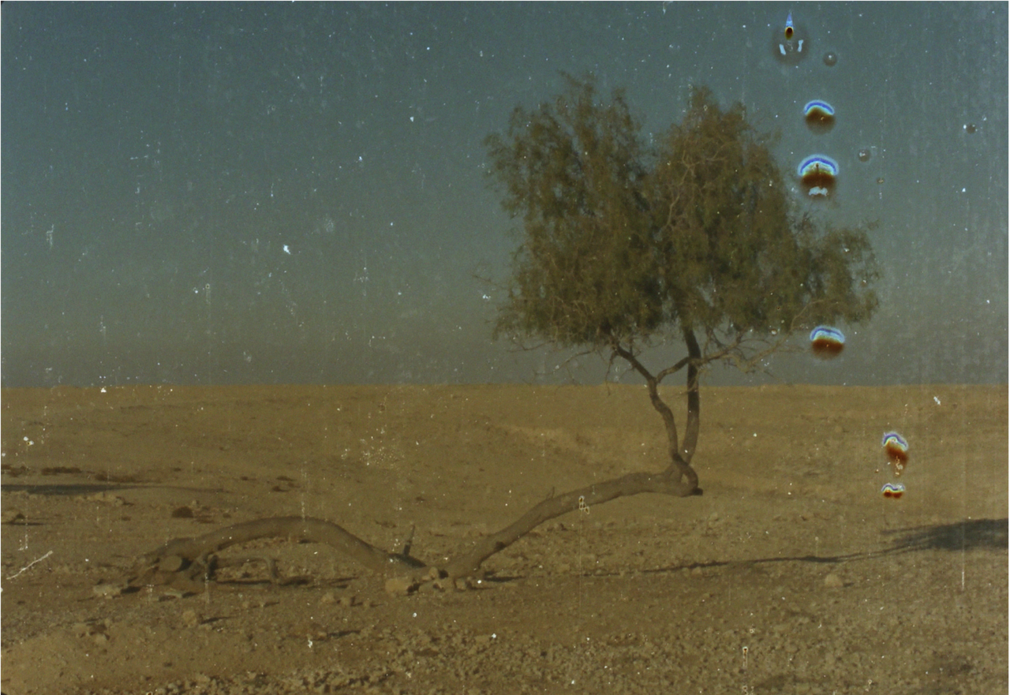
Vents Violents is a dialogue with the absence of Belgian Jewish filmmaker Chantal Akerman. The film follows her footsteps along route 3199 in Al-Naqab desert in southern Israel/colonized Palestine, where she filmed scenes that were used in her last film No Home Movie (2015). Between two letters, in French and in Yiddish, Vents Violents travels through Akerman’s route while turning the camera towards evidence of colonial practices carried out in this desert on a daily basis, yet hidden from Akerman’s camera. In its second part, the film reaches a dead end. The attempt to mourn Akerman in time of a ravaging genocide in Gaza – committed by Israel as the world turns a bling eye – is tormenting. The film asks to destabilize the sense of reading localities via images, constantly shifting between video and 16mm film, as it moves from Al Naqab desert to Père-Lachaise Cemetery in Paris.
The film is a reckoning with the blind spot of European Jewry towards the settler colonization of Palestine by Zionism and the ongoing Palestinian Nakba.
Orientation
2015, HD video, color, 16:9, stereo sound, BE, 2015, 12’
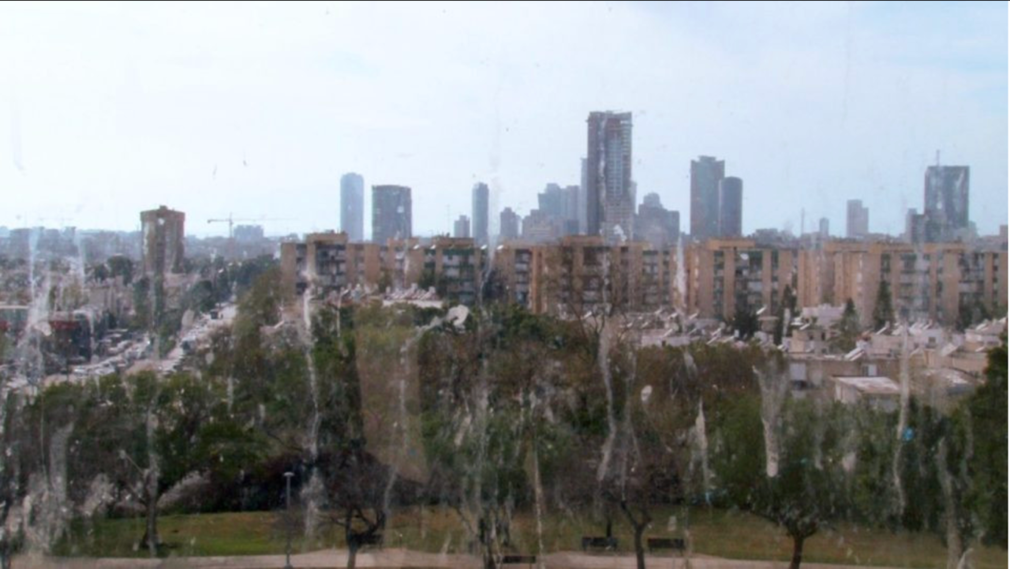
Looking at two locations— the public sculpture White Square commemorating the founders of Tel Aviv, and the shrine of Palestinian village Salame in today’s Israeli Kafar Shalem—Orientation focuses on the ability of architectural material, and of sound and image, to register collective forgetfulness.
In 1989, the Israeli sculptor Dani Karavan, completed his sculpture White Square. The work was commissioned by the Municipality of Tel Aviv, and by the end of the building process Karavan decided to dedicate the sculpture to the founders of Tel Aviv—among whom his father Abraham Karavan, who was the city’s landscape architect for four decades from 1930’s onwards. The sculpture is composed of simple geometrical shapes and is made of white concrete, influenced by the International Style of early architecture in Tel Aviv. White Square—situated on the highest point in the area located in the eastern outskirts of Tel Aviv—overlooks through the skyscrapers all the way to the Mediterranean Sea in the west. The commonly used name of the hill on which White Square is exalted on a hill which name is pronounced in Arabic: “Giv’at Batih” (Watermelon Hill).
The remains of the shrine of Salame, in today’s Tel Avivian neighbourhood Kfar Shalem is located a few hundred meters south of this hill. The abandoned dome-structure was once at the centre of the ancient Palestinian village Salame. The village, dating back to the 16th century up until 1948, was located on the highway from Jaffa Port to the mainland. During the ‘Nakba’ of 1948 it was occupied and depopulated by the Israeli Army and the new Zionist state. Weeks after expelling the Palestinian villagers from their land, the Israeli authorities—managing waves of Jewish immigration—re-inhabited the village with Yemenite Jews. Those, were settled in the original Palestinian stone houses. Today, decades later, the ownership of the land is still in dispute, and the Jewish-Israeli residents of Kfar Shalem are threatened with evacuation due to a construction-corporations’ plan to destroy the stone houses and to build a new profitable neighbourhood.
1. Juli 2026, 19 Uhr
Lehrgebiet Film
Raum 9, Hauptgebäude EG