Susanne Wieland
Design for and with urban wild pockets: Investigation of spontaneous urban ecosystems and the material and ecological consequences of anthropogenic design
Department of Design
In response to the current environmental crisis and ongoing global urbanisation, the relationship between design and nature is being re-evaluated in design research.
In urban areas, the effects of human intervention are evident in adaptation and transformation processes that extend to the urban evolution of some urban species. While many of these changes can be attributed to design decisions, many others lie beyond the direct control of designers. Design can therefore be understood as an inextricably entangled process with ecological actors, whereby the designed objects are continuously interwoven with others in multi-species networks. Consequently, nature should not be considered merely as an external reference in the design process, but rather as an active participant with influence and agency, or at the very least as a affected entities.
Drawing on the principles of 'more-than-human' design, as well as anthropological and urban ecological perspectives, this research project investigates how man-made structures are used and potentially redesigned by other living beings and ecosystems. The effects of this non-human co-use will be analysed systematically from a design perspective in order to re-evaluate their significance in the context of future multispecies communities.
The analysis of a specific field of study, which features both ruderal and design elements, enables the exploration of the interactions and interrelationships between material and ecological structures. In this context, the ecosystem can be regarded as a ‘living archive’ that stores and reveals cultural, ecological and historical traces of human activities. Furthermore, new opportunities and challenges for the design process can be derived from this.
The project aims to investigate how design can operate within the tension between care and control for ecological agencies.
Supervisors
Prof. Dr. Tom Bieling
Projects
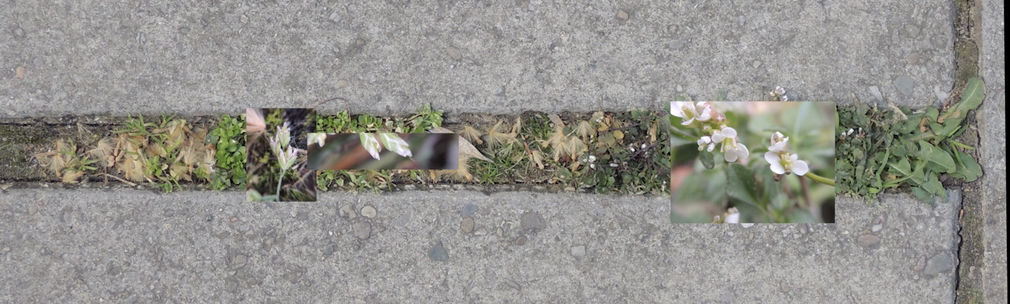
The Hidden Life of a Pavement Crack
Mapping some of the infinite stories of a single London pavement crack. (2021)
Credits: Susanne Wieland
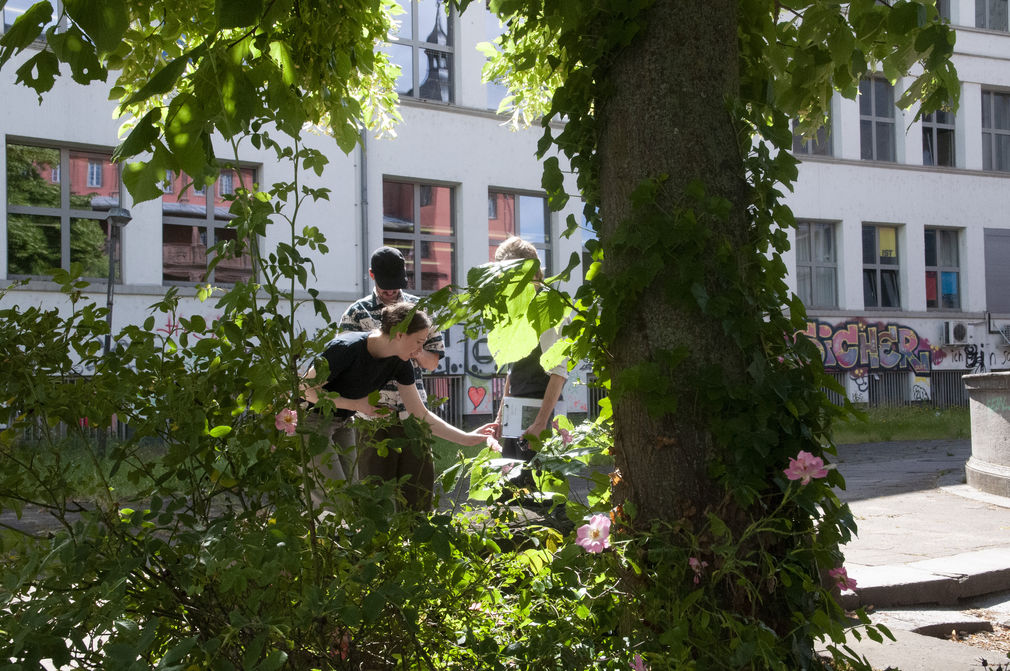
Fields of Coexistence – Workshop and Fieldtrip
Mapping of ecological co-inhabitants of the HfG Schlossplatz. (2026)
Credits: green.office_ HfG
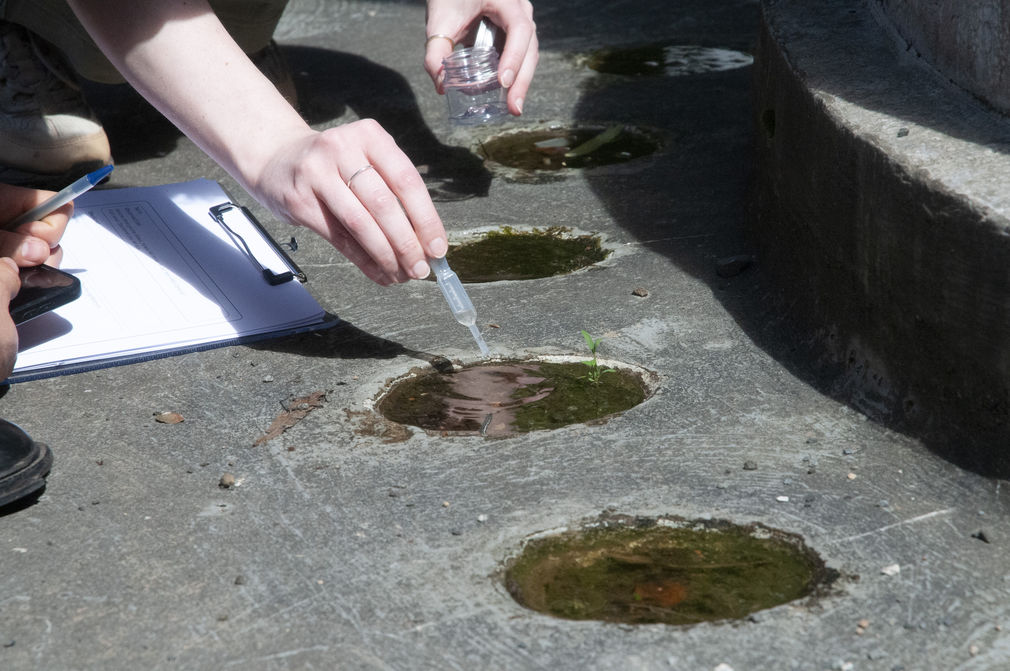
Fields of Coexistence – Workshop and Fieldtrip
Samples taken from the well on HfG-Schlossplatz for microscopic analysis. (2026)
Credits: green.office_HfG